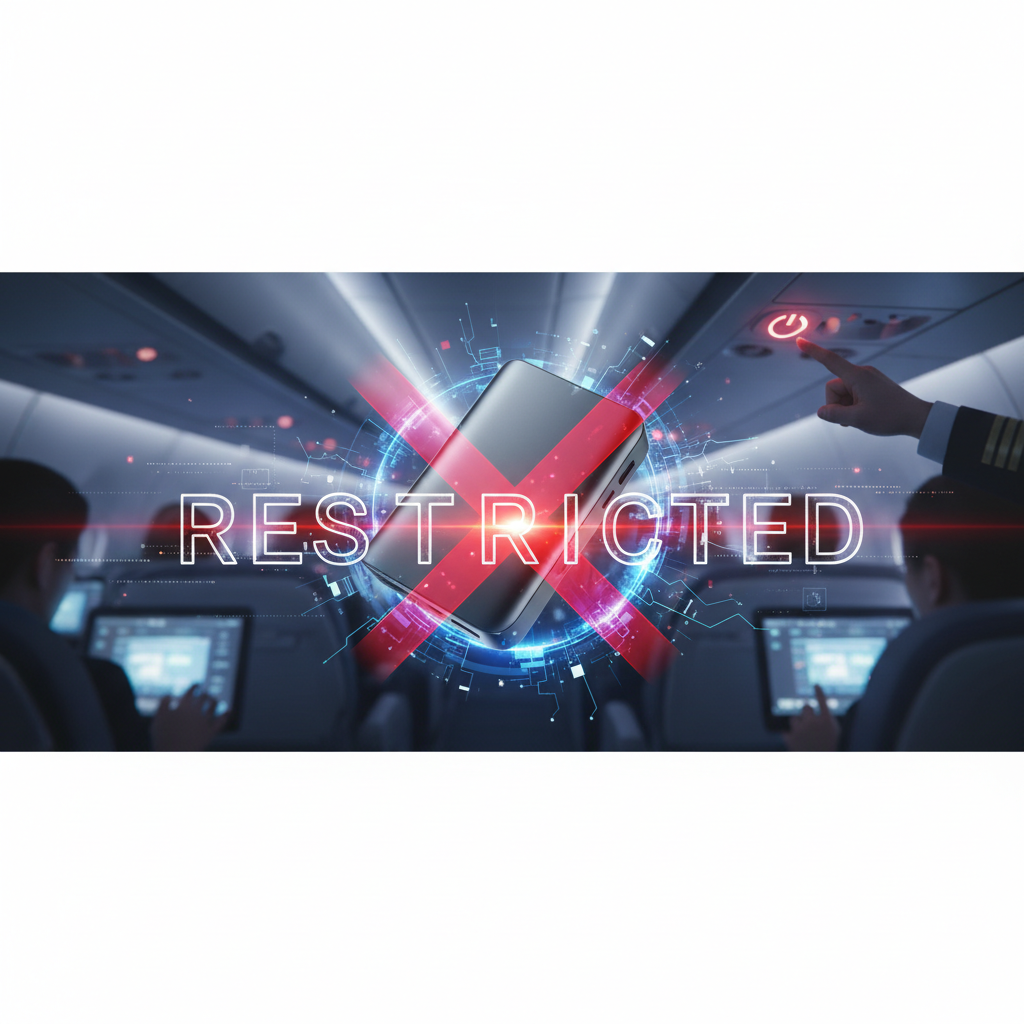
In an era defined by constant connectivity, our reliance on portable electronic devices — and the power banks that fuel them — has become almost absolute. From managing crucial business communications mid-air to keeping children entertained on long-haul flights, these pocket-sized energy reserves are indispensable companions for millions of travelers worldwide. Yet, as our devices become more sophisticated and their batteries more powerful, a critical safety challenge has emerged, prompting aviation authorities globally to reassess and often tighten the rules governing lithium-ion battery use aloft.
Recently, the Turkish Directorate General of Civil Aviation (Sivil Havacılık Genel Müdürlüğü) announced a significant restriction: the prohibition of charging power banks onboard aircraft. This isn't an isolated incident but rather a trend reflecting a broader, global shift in aviation safety protocols designed to mitigate the specific risks posed by lithium-ion batteries. As senior editorial writers for biMoola.net, a platform dedicated to the intersection of AI, Productivity, HealthTech, and Sustainable Living, we understand that these changes, while rooted in safety, have significant implications for productivity and travel convenience.
This comprehensive guide will demystify the new power bank regulations, explain the crucial \"why\" behind them, and equip you with the knowledge and practical strategies to navigate the skies safely and efficiently. We'll delve into the science of battery safety, explore the global regulatory landscape, and offer actionable advice to ensure your devices remain charged and compliant, without compromising your journey.
The Evolving Landscape of Aviation Safety: A Proactive Stance
Aviation safety is a dynamic field, constantly adapting to technological advancements and emerging risks. For decades, the focus was primarily on mechanical integrity, navigation, and human factors. However, the proliferation of lithium-ion (Li-ion) batteries in consumer electronics has introduced a relatively new and complex challenge for air transport. These batteries, while offering high energy density and light weight, carry a inherent risk of thermal runaway under certain conditions, leading to fire.
A History of Concern: From Cargo to Cabin
Concerns about Li-ion batteries are not new. For years, there have been restrictions on shipping loose Li-ion batteries as cargo due to numerous documented incidents of fires in freight compartments. However, the challenge intensified as these batteries became ubiquitous in personal devices carried by passengers. The International Civil Aviation Organization (ICAO), a UN specialized agency, has been at the forefront of establishing international standards for dangerous goods in air transport, including batteries.
According to data compiled by the U.S. Federal Aviation Administration (FAA), there were over 400 air transport incidents involving lithium batteries between 2006 and 2023. While many of these were minor, a significant number involved smoke, fire, or extreme heat. These incidents, though rare compared to the total number of flights, underscore the potential for catastrophic consequences at 35,000 feet. The growth of incidents, albeit small, aligns with the exponential increase in portable device ownership. For example, a 2023 report by Statista projected that the number of smartphone users worldwide would reach 6.8 billion by 2028, each relying on Li-ion technology.
The Rationale Behind New Restrictions
The recent prohibition on charging power banks onboard, as seen with the Turkish Directorate General of Civil Aviation's move, stems directly from this historical context and the evolving understanding of Li-ion battery risks. While carrying power banks in carry-on luggage has long been mandated (as opposed to checked baggage, where a fire would be far more difficult to detect and extinguish), the act of charging introduces additional variables:
- Heat Generation: Charging cycles inherently generate heat, increasing the risk of overheating if the battery is faulty or mishandled.
- Incompatible Chargers: Passengers might use non-standard, damaged, or incompatible charging cables/adapters, which can lead to overcharging or short-circuiting.
- Unattended Charging: A power bank could be left charging unattended, particularly during sleep, delaying detection of an issue.
- Compartment Conditions: Power outlets on aircraft might not always provide stable power, potentially stressing battery management systems.
These factors collectively elevate the risk of a thermal event, even for compliant power banks. The restriction is therefore a proactive measure to eliminate a known risk factor in a confined, high-stakes environment.
Understanding the \"Why\": The Perils of Lithium-ion Batteries in Flight
To truly grasp the importance of these regulations, it's essential to understand the inherent characteristics of lithium-ion batteries that make them a concern for aviation safety. These compact powerhouses are marvels of modern engineering, but their design involves highly reactive materials.
Thermal Runaway: The Nightmare Scenario
The primary concern with Li-ion batteries is a phenomenon known as thermal runaway. This occurs when a battery's internal temperature rapidly increases, leading to a chain reaction where the heat generated causes further chemical reactions, which in turn generate more heat. It's a self-sustaining cycle that can quickly escalate.
Factors that can trigger thermal runaway include:
- Internal Short Circuits: Often caused by manufacturing defects, damage from drops, or piercing.
- External Short Circuits: When the positive and negative terminals come into contact, often due to improper storage or damaged cables.
- Overcharging: Forcing too much current into the battery, exceeding its voltage limits.
- Over-discharging: Although less common, deep discharge can sometimes damage internal structures.
- Exposure to High Temperatures: External heat sources or a hot cabin environment can exacerbate existing issues.
Once thermal runaway begins, it's incredibly difficult to stop. The battery can vent flammable gases, produce smoke, and ultimately ignite, leading to a significant fire that can spread rapidly. This is particularly dangerous in an aircraft cabin, where resources to combat such a fire are limited.
The Fire Risk and Aircraft Systems
Aircraft fire suppression systems are designed to handle specific types of fires, primarily those involving engine fuel or electrical components. However, Li-ion battery fires present unique challenges:
- Oxygen Generation: Some battery chemistries, when in thermal runaway, can produce their own oxygen, making them incredibly difficult to extinguish with conventional methods like Halon gas, which works by displacing oxygen.
- Re-ignition: Even if initially suppressed, a Li-ion battery fire can re-ignite hours later if residual heat remains or if other cells within the battery pack are affected.
- Toxic Fumes: Burning batteries release noxious and toxic fumes that pose a significant health risk to passengers and crew.
The National Transportation Safety Board (NTSB) has consistently highlighted the risks posed by Li-ion batteries, issuing numerous safety recommendations to mitigate these dangers in both passenger and cargo operations. A 2017 NTSB report, for instance, specifically addressed the challenges of fighting lithium battery fires on aircraft, urging improved fire suppression capabilities.
Navigating Current Power Bank Regulations: What You MUST Know
While the new restriction on charging power banks onboard is a specific update, it builds upon a foundation of existing regulations. Understanding these broader rules is critical for any traveler.
Capacity Limits and Carry-On Mandates
The fundamental rule for power banks (and
Comments (0)
To comment, please login or register.
No comments yet. Be the first to comment!