AI Tools

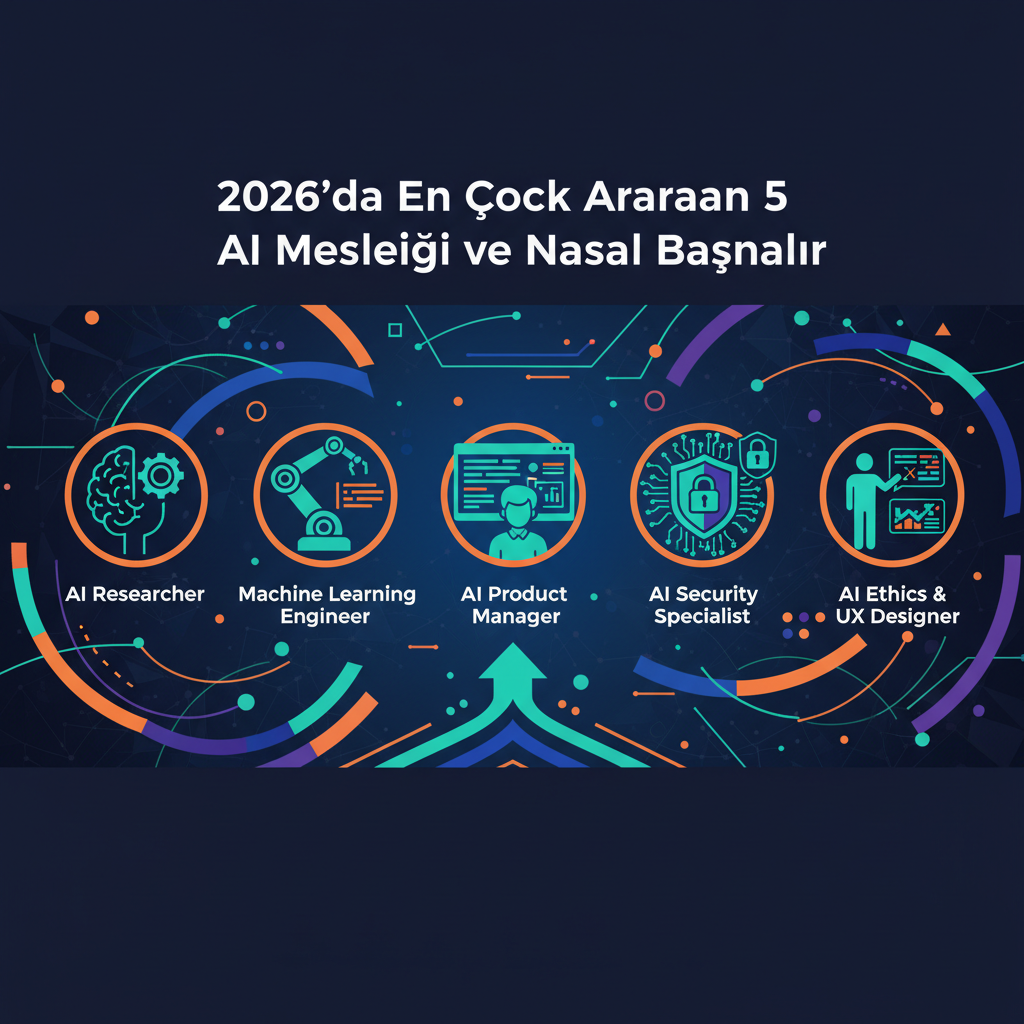
Top 5 Most Sought-After AI Jobs in 2026 and How to Get Started

Top 5 Most Sought-After AI Jobs in 2026 and How to Get Started

AI Revolution and Future Professions: Welcome to 2026!

My dear readers, we are in the midst of an unprecedented transformation in the history of technology: the Artificial Intelligence revolution. As we reach 2026, we are personally experiencing how profoundly AI has changed the way we work, communicate, and even think. These technologies, once the subject of futuristic science fiction films, have now become the driving force of the global economy and the main source of career opportunities. So, in this rapidly changing world, how can you carve out a place for yourself and advance your career into the future?

In this comprehensive blog post, I will put the spotlight on the top 5 most sought-after AI professions in 2026, explain why each is so critical, and provide concrete guides on how you can step into these exciting fields. If you want to reshape your career with artificial intelligence and take a place in the brightest professions of the future, you are in the right place!

Why Are AI Professions So Important in 2026?

As of 2026, artificial intelligence is no longer just a part of large tech companies' operations, but a fundamental component for businesses of all sizes across every industry. From manufacturing to healthcare, education to finance, AI-powered solutions are increasing efficiency, reducing costs, and accelerating innovation in all areas. This situation exponentially increases the need for experts who can develop, manage, optimize, and use AI systems within ethical frameworks. As traditional professions transform, next-generation AI jobs inevitably emerge.

Top 5 Most Sought-After AI Professions of 2026 and a Starter Guide

1. AI Prompt Engineer

What is it? This expert writes complex and precise commands (prompts) to get the best results from generative AI models (such as GPT-X, DALL-E, Midjourney). Considering that by 2026, all kinds of content (text, visual, code, audio) are generated by AI, this profession has become one of the most critical interfaces between AI and humans. They are, in a sense, translators who speak the language of AI.

  • Key Competencies: Understanding of Natural Language Processing (NLP), creativity, analytical thinking, experimental approach, problem-solving, domain knowledge (marketing, software, design, etc.).
  • How to Get Started? Mastering the Python programming language, practicing with popular generative AI models (e.g., OpenAI APIs), taking online courses on prompt engineering (Coursera, Udemy), developing your own projects, and creating a prompt engineering portfolio are critical. Blogs and community forums are also ideal resources for continuous learning.
  • Real-Life Example: A prompt engineer designing special prompts to generate product descriptions, ad copy, and social media posts for an e-commerce company can achieve 30% higher conversion rates.

2. AI Trainer / Model Trainer

What is it? This person provides human feedback to machine learning models to ensure they operate more accurately, impartially, and effectively. This role is especially needed for fine-tuning large language models (LLMs) and other generative AIs, avoiding undesirable outputs, and ensuring they remain within ethical boundaries. As AI's influence on decision-making processes increases by 2026, human-centric supervision and training are indispensable.

  • Key Competencies: Detail-oriented, analytical thinking, strong communication, ethical awareness, domain knowledge (for AI requiring expertise in areas like healthcare, law, finance), data labeling experience.
  • How to Get Started? Understanding the basic principles of AI, learning data labeling and annotation tools (platforms like Amazon SageMaker Ground Truth, Scale AI), and having a background in linguistics or a related field provides an advantage. You can gain experience by participating in "human-in-the-loop" programs offered by various AI platforms.
  • Concrete Suggestion: An AI trainer who labels correct and incorrect diagnosis examples while training a healthcare AI for disease diagnosis, thereby increasing the model's accuracy, plays a life-saving role.

3. AI-Focused Data Scientist

What is it? This expert goes beyond traditional data science, establishing, managing, and analyzing the data infrastructure necessary for the development, training, and deployment of artificial intelligence models. In 2026, the concept of "data" is seen not just as raw information, but as the vital resource that feeds and trains AI. This profession is responsible for collecting, cleaning, processing, and performing feature engineering on the right data for AI models.

  • Key Competencies: Programming languages like Python/R, machine learning algorithms, statistics, data visualization, big data technologies (Spark, Hadoop), cloud platforms (AWS, Azure, GCP), MLOps principles.
  • How to Get Started? Graduating from a quantitative field such as computer science, statistics, or mathematics, participating in data science competitions on platforms like Kaggle, pursuing AI and machine learning-focused bootcamps and master's programs, and building a data analysis portfolio are important.
  • Practical Tip: A data scientist performing credit risk modeling at a financial institution can prevent millions of dollars in losses by developing next-generation AI-powered fraud detection algorithms.

4. AI Ethics and Security Specialist

What is it? This is a key role that ensures artificial intelligence systems are developed and used in a fair, transparent, secure, and human rights-respecting manner. Given AI's profound impact on societal life in 2026, the risks of bias, discrimination, data privacy breaches, and misuse are increasingly growing. These specialists formulate AI policies, conduct risk assessments, and perform ethical audits.

  • Key Competencies: Knowledge of ethics and philosophy, law and regulations (such as GDPR, AI Act), cybersecurity principles, understanding of AI's technical foundations, risk management, strong communication and negotiation skills.
  • How to Get Started? Coming from diverse disciplines such as law, philosophy, sociology, or computer science, and participating in certification programs on AI ethics and security. Keeping up with and specializing in current regulations like the EU Artificial Intelligence Act provides a significant advantage.
  • Concrete Example: An ethics specialist who defines the usage principles for an AI-powered facial recognition system in a public institution ensures the system is used correctly and personal privacy is protected.

5. AI Solutions Architect / Consultant

What is it? This is a strategic role that designs artificial intelligence solutions for businesses' specific needs, plans their integration with existing systems, and formulates overall AI strategies. In 2026, while every company wants to adopt AI, knowing which AI technology is best suited for which business problem and implementing it is a major challenge. These experts combine technical knowledge with business acumen.

  • Key Competencies: Strong business analysis skills, deep knowledge of AI and machine learning, cloud architectures (AWS ML, Azure AI, Google AI), project management, customer relations, presentation and persuasion skills.
  • How to Get Started? Having a background in engineering, computer science, or business, obtaining comprehensive certifications in AI and cloud technologies (e.g., AWS Certified Machine Learning – Specialty), gaining experience in business analysis and project management, and being proficient in AI usage scenarios across different industries.
  • Practical Tip: An AI solutions architect who proposes an AI-based solution for inventory optimization and demand forecasting to a retail company and outlines the implementation roadmap can save millions of dollars.

Common Advice for the Future and Continuous Development

Although the artificial intelligence professions I mentioned above require different specializations, there are some fundamental competencies they all share:

  1. Continuous Learning: The field of AI is advancing so rapidly that what you learned yesterday might be outdated today. Keep yourself constantly updated through online courses, MOOCs, blogs, technical articles, and conferences.
  2. Hands-on Experience: Theory is important, but practice is invaluable. Develop your own AI projects, share code on GitHub, and contribute to open-source projects. Creating an AI portfolio will give you an edge in job applications.
  3. Networking: Connect with professionals in the industry. LinkedIn, AI communities, and local meetups are great platforms for exchanging information and finding career opportunities.
  4. Ethical Awareness: Regardless of which AI profession you are in, understanding the ethical implications of the systems you develop or use and being responsible is essential for 2026 and beyond.

Conclusion: Start Your AI Career Now!

The year 2026 is full of opportunities offered by artificial intelligence. The top 5 most sought-after AI professions we covered in this article offer career paths that will put you a step ahead in the future job market. Whether you speak the language of AI as an AI Prompt Engineer, add a human touch to models as an AI Trainer, make data speak as an AI-Focused Data Scientist, ensure a fair and secure future as an AI Ethics Specialist, or add vision to companies as an AI Solutions Architect; the choice is yours.

Remember, those who build the future are those who adapt to change and embrace innovation. You also have a place in the artificial intelligence revolution!

Start today by applying the steps mentioned above to take your first step into this exciting field. The knowledge and motivation you need to advance to the next level in your career are hidden in this article!

Comments (0)

No comments yet. Be the first to comment!

biMoola Assistant
Hello! I am the biMoola Assistant. I can answer your questions about AI, sustainable living, and health technologies.