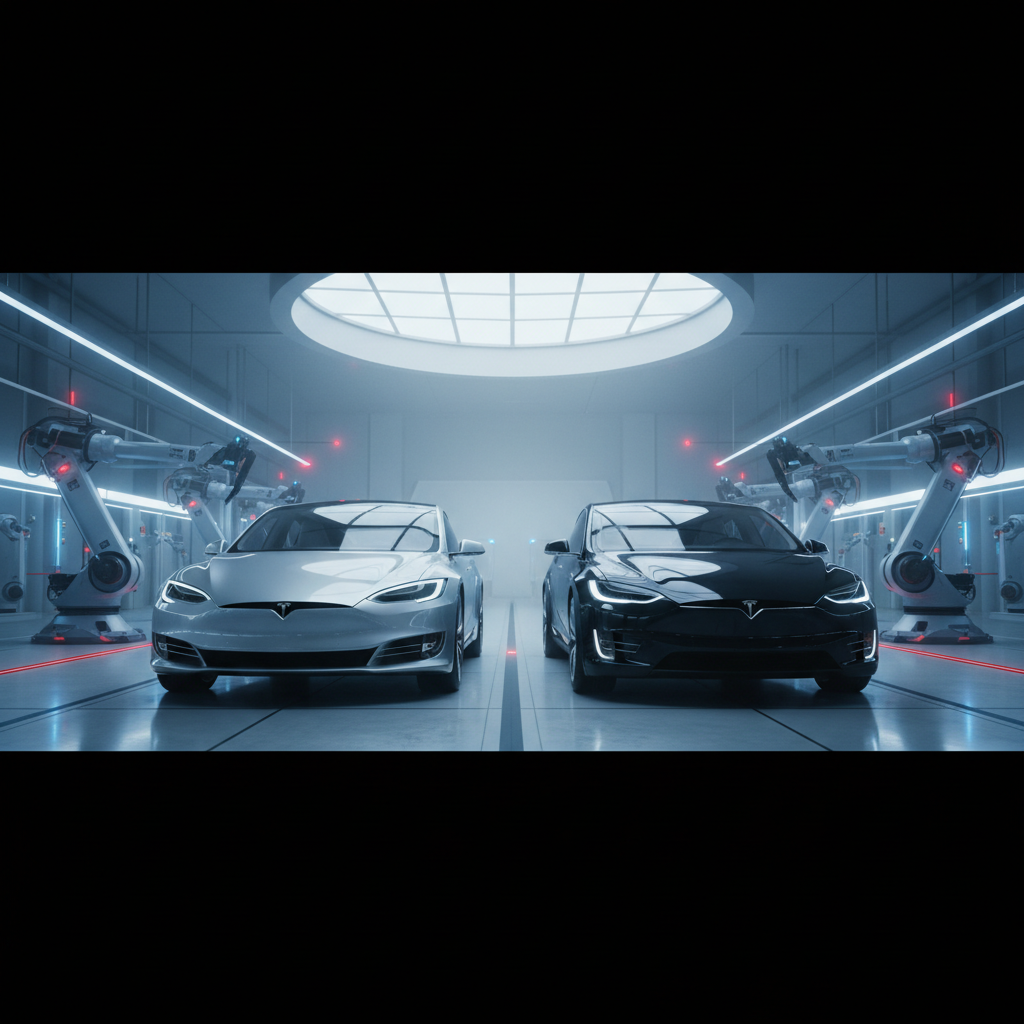
Few companies embody the spirit of technological disruption and ambitious futurism quite like Tesla. From revitalizing the electric vehicle (EV) market to challenging established automotive norms, Tesla has consistently charted its own course. The recent news, initially reported in Turkish media outlets like ShiftDelete.net, detailing the official cessation of Model S (after 14 years) and Model X (after 11 years) production, marks not just the end of an era but a profound strategic pivot. This isn't merely a production adjustment; it's a clear signal that Tesla is accelerating its transformation from a premium electric car manufacturer to a diversified AI, robotics, and autonomous mobility powerhouse.
At biMoola.net, we delve beyond the headlines. This article will provide an in-depth analysis of what this strategic shift truly signifies for Tesla, the broader automotive industry, and the future of sustainable living. We'll explore the historical legacy of the Model S and X, dissect the financial and technological imperatives driving this decision, and forecast the implications for consumers, investors, and the global AI landscape. Prepare to understand not just what happened, but why, and what comes next in Tesla's relentless pursuit of an autonomous future.
The End of an Era: A Look Back at Tesla's Pioneering Sedans
To truly grasp the magnitude of the Model S and X production halt, one must first appreciate their indelible impact on the automotive world. These weren't just cars; they were statements, catalysts, and often, controversial standard-bearers that forced an entire industry to reconsider its future.
The Model S Legacy: Setting the EV Standard
When the Model S first rolled off the assembly line in 2012, it was nothing short of revolutionary. At a time when electric vehicles were largely relegated to compact, range-limited compromises, the Model S offered blistering performance, impressive range (surpassing 200 miles initially, later extending beyond 400 miles), and a luxury interior dominated by a massive touchscreen. It challenged the notion that EVs had to be niche, proving they could be desirable, high-performing, and aesthetically pleasing.
The Model S didn't just compete with internal combustion engine (ICE) luxury sedans; it often outperformed them. Its over-the-air (OTA) software updates, a concept largely unheard of in the automotive sector, meant cars improved over time, adding features, enhancing performance, and even fixing bugs without a trip to the service center. This introduced a tech-centric, iterative development model that has since been emulated, albeit imperfectly, by numerous legacy automakers. In many ways, the Model S was the iPhone of the automotive industry, redefining expectations and setting the benchmark for what a modern car could be.
The Model X: Innovation Meets Utility
Following the Model S, the Model X, launched in 2015, pushed boundaries further. As Tesla's first SUV, it aimed to blend utility with the brand's signature performance and high-tech features. Its distinctive 'falcon wing' doors were a bold engineering feat, though not without their initial production complexities. The Model X introduced a large panoramic windshield, ample storage, and the option for a third row, making it a compelling choice for families seeking an electric alternative without sacrificing practicality or luxury.
While the Model X never achieved the same sales volume or cultural omnipresence as the Model S or later the Model 3, it demonstrated Tesla's willingness to innovate in design and engineering. It further solidified Tesla's position as a technology company first, and a car company second, setting the stage for even more ambitious ventures down the line. Both vehicles, despite their eventual discontinuation, leave an enduring legacy as the pioneers that helped transition EVs from a fringe idea to a mainstream reality.
Why Now? Unpacking Tesla's Strategic Pivot
The decision to cease production of flagship models is never taken lightly, especially for a brand like Tesla, which built its initial reputation on these very vehicles. This move is far from arbitrary; it's a calculated, multifaceted strategic pivot driven by financial imperatives, manufacturing evolution, and an unwavering commitment to a future defined by autonomy and AI.
Streamlining Production for Scale
Tesla's CEO, Elon Musk, has often stressed that the ultimate challenge is not designing an electric car, but manufacturing it at scale efficiently. The Model S and X, while innovative, were comparatively complex to produce, featuring custom parts, intricate wiring, and, in the case of the Model X, the demanding falcon-wing door mechanism. In contrast, the Model 3 and Model Y, and especially the forthcoming next-generation platform (often colloquially referred to as the 'Model 2' or 'Robotaxi'), are designed from the ground up for radical manufacturing simplification and cost reduction.
Concepts like 'gigacasting,' where large sections of a vehicle's underbody are cast as a single piece, and 'unboxed assembly,' which involves assembling major sub-assemblies simultaneously rather than sequentially on a traditional line, are central to this strategy. A 2023 S&P Global Mobility report highlighted gigacasting's potential to reduce manufacturing costs by 40% and factory footprint by 30%. By shedding the manufacturing overhead of the S and X, Tesla can reallocate engineering talent and production line capacity in its Gigafactories (like those in Fremont, Texas, and Berlin) towards higher-volume, simpler-to-produce vehicles. This streamlines the operational pipeline, reduces complexity, and significantly boosts overall productivity, aligning perfectly with biMoola.net's focus on efficiency.
Financial Imperatives: Maximizing Margins
While luxury vehicles often carry high sticker prices, their profit margins can be surprisingly intricate due to lower production volumes, bespoke components, and higher warranty costs. The Model S and X, despite their premium positioning, likely did not offer the same robust profit margins as the higher-volume Model 3 and Y, let alone the projected margins of a next-gen, cost-optimized vehicle designed for mass consumption and robotaxi fleets. Tesla's Q4 2023 earnings call revealed continued pressure on average selling prices (ASPs) and margins due to price cuts and investments in future growth.
By phasing out older, more complex models, Tesla can concentrate its resources on platforms that promise superior economies of scale and, crucially, higher profitability per unit. This financial discipline is paramount as Tesla navigates a more competitive EV landscape and self-funds its ambitious AI and robotics ventures. Investing capital in models with declining market share and lower relative margins would be counter-productive to the company's long-term financial health and its ability to innovate rapidly.
Resource Reallocation: Fueling the AI and Robotics Ambition
Perhaps the most significant driver behind this decision is Tesla's deepening commitment to becoming an AI and robotics company, with its automotive division serving as the primary proving ground and revenue generator for these broader ambitions. Elon Musk has consistently stated that Full Self-Driving (FSD) is the 'holy grail' and the key to Tesla's long-term valuation, seeing the company not just as a carmaker but as a leader in artificial intelligence.
Ending production of the S and X frees up engineering teams, capital, and even factory space that can now be laser-focused on accelerating FSD development, enhancing the Dojo supercomputer's capabilities, and advancing the Optimus humanoid robot project. These initiatives are incredibly capital-intensive and require vast pools of talent. By narrowing its automotive product range, Tesla can reallocate its most precious resources — its brilliant engineers and substantial R&D budget — towards these next-generation technologies. This strategic shift underlines Tesla's belief that its future lies not just in selling individual vehicles, but in selling autonomous mobility services and generalized AI.
The Autonomous Horizon: Tesla's Future Vision
The strategic move away from its legacy luxury vehicles isn't just about efficiency; it's about accelerating towards a singular, profound vision: a fully autonomous, AI-driven future where transportation, labor, and perhaps even daily life are transformed. This future, as envisioned by Tesla, extends far beyond mere electric cars.
Full Self-Driving (FSD) and Robotaxis: The Core Bet
At the heart of Tesla's future is its Full Self-Driving (FSD) technology. Despite ongoing regulatory scrutiny, public skepticism, and significant engineering challenges, Tesla views FSD as its most valuable asset. The vision is to evolve beyond selling vehicles to selling miles, through a vast network of autonomous robotaxis. These vehicles, operating 24/7 without human intervention, promise dramatically lower transportation costs per mile, increased safety by eliminating human error, and optimized urban mobility.
As of early 2024, Tesla's FSD Beta program has accumulated billions of miles of real-world driving data, providing an unparalleled dataset for AI training. This data feeds into the company's continuous iterative development, aiming to solve the complex 'edge cases' that still challenge autonomous driving systems. The next-generation vehicle platform is explicitly designed to be a robotaxi first, with an interior optimized for ride-sharing rather than individual ownership, signaling the company's intent to capture a significant portion of the burgeoning autonomous mobility market, which a 2023 McKinsey & Company report projects to be a multi-trillion-dollar industry.
Beyond Cars: Dojo, Optimus, and General AI
Tesla's autonomous ambitions extend well beyond passenger vehicles. The Dojo supercomputer, designed specifically for training AI models for video processing, is a testament to this broader vision. It's not just for FSD; its capabilities are foundational for any vision-based AI system. Similarly, the Optimus humanoid robot, first unveiled in 2021, aims to automate repetitive, dangerous, or mundane tasks in various environments, from factories to homes. While still in its early stages, Optimus represents Tesla's foray into generalized AI and robotics, a field with potentially limitless applications and market opportunities.
This ecosystem — FSD generating massive datasets, Dojo training sophisticated AI models, and Optimus applying that intelligence to the physical world — paints a picture of a company aiming to be a leader in general artificial intelligence. The automotive division, in this context, becomes a highly successful proof-of-concept and a cash cow to fund these grander ambitions.
Urban Mobility and Sustainable Impact
For biMoola.net, with its focus on sustainable living, the autonomous future envisioned by Tesla holds significant implications. A widespread robotaxi fleet, coupled with efficient electric vehicles, could dramatically reduce the number of privately owned cars, ease urban congestion, and free up vast swathes of land currently used for parking. This paradigm shift could lead to more efficient resource allocation, lower per-capita energy consumption in transport, and significantly reduced emissions, especially if charging infrastructure is powered by renewable sources.
Moreover, the integration of AI could optimize traffic flow in real-time, anticipate demand, and even inform urban planning decisions for more livable, sustainable cities. This future aligns with the highest ideals of sustainable living, leveraging advanced technology to create a more harmonious and efficient relationship between humans and their environment.
Market Implications and Industry Reactions
Tesla's strategic realignment sends ripples across the entire automotive and technology landscape. It challenges competitors, redefines brand perception, and has significant implications for consumers and investors alike.
Competitor Landscape: Who Benefits, Who Adapts?
The exit of Model S and X from production creates a vacuum in the premium EV sedan and SUV segments, potentially opening doors for rivals. Luxury automakers like Mercedes-Benz (with its EQE and EQS), BMW (i7, iX), Lucid (Air), and Porsche (Taycan) are increasingly fielding highly competitive, technologically advanced EVs that directly challenge Tesla's former high-end dominance. These brands could capitalize on affluent buyers who still prefer traditional ownership of a luxury vehicle rather than waiting for an autonomous fleet.
However, the broader implication is that Tesla is signaling a shift away from competing head-to-head in the luxury segment to focus on mass-market affordability and the disruptive potential of autonomy. This could compel competitors to accelerate their own autonomous driving programs and re-evaluate their long-term product strategies. Those who fail to adapt to the mass-market EV transition and the eventual autonomous future risk being left behind.
Consumer Sentiment and Brand Evolution
For existing Model S and X owners, the news might evoke a mix of nostalgia and concern, though Tesla has a strong track record of continuing software updates and service for its older models. For prospective premium buyers, Tesla's brand is evolving. While still synonymous with cutting-edge EVs, the emphasis is shifting from a luxury performance car to a technology platform. This evolution might alienate a segment of traditional luxury car buyers who value craftsmanship and exclusivity above all else, but it aims to attract a new generation of consumers who prioritize technological advancement, efficiency, and potentially, autonomous services.
The success of this pivot hinges on Tesla's ability to execute its FSD vision reliably and safely, and to deliver compelling, affordable next-generation vehicles. The brand's reputation is increasingly tied to the promise of full autonomy, a promise that, while revolutionary, carries significant risk and public expectation.
Expert Analysis: A Calculated Risk or Visionary Leap?
At biMoola.net, we view Tesla's decision to discontinue Model S and X production as a quintessential Tesla move: audacious, high-stakes, and potentially transformative. It is, in our assessment, a calculated risk that leans heavily into a visionary leap, underscoring the company's belief in its own unique trajectory.
The logic is sound from a resource allocation perspective. Maintaining and updating two relatively lower-volume, complex-to-manufacture models diverts capital, engineering talent, and manufacturing capacity from what Tesla clearly believes are its true growth engines: mass-market affordability, radical production efficiency, and, above all, the exponential potential of AI and autonomy. This is a company declaring that its future isn't about incrementally improving cars, but fundamentally reinventing mobility and, by extension, human-robot interaction.
However, the risk is palpable. By ceding the premium EV segment, Tesla risks losing some of its aspirational appeal and allowing competitors to gain a stronger foothold in the high-margin luxury market. More critically, the entire strategy is predicated on the successful, widespread deployment of Full Self-Driving. Despite immense progress, FSD remains a work in progress, facing significant technical hurdles and an evolving regulatory landscape. If FSD does not achieve its promised capabilities or faces prolonged delays, the financial and reputational ramifications for Tesla could be severe.
Our analysis suggests this move reinforces Tesla's long-term strategy of vertical integration and technological supremacy. They are not merely an automaker; they are attempting to become the defining AI and robotics company of the 21st century, using automotive as their beachhead. The Model S and X were critical in establishing that beachhead, but now, the war is for autonomy, and Tesla is shedding what it perceives as legacy baggage to focus all its might on the next battle. It's a gamble, yes, but one rooted in a deep understanding of technological inflection points and a willingness to bet the farm on first-principles innovation.
The Road Ahead: What to Expect from Tesla
With the Model S and X now part of history, Tesla's future product roadmap and strategic focus become clearer and more concentrated. The coming years will be defined by an intense push on specific fronts, all designed to actualize their grand vision.
Next-Gen Vehicle Platforms (Model 2/Robotaxi)
The immediate and most tangible outcome of this pivot will be the accelerated development and rollout of Tesla's next-generation vehicle platform. This platform is anticipated to underpin a significantly lower-cost vehicle, often referred to as the 'Model 2,' designed for mass adoption, and simultaneously serve as the foundation for dedicated robotaxi units. The focus will be on radical cost reduction (potentially 50% less than Model 3 production costs, as hinted by Musk), achieved through advanced manufacturing techniques like gigacasting and 'unboxed' assembly. These vehicles are expected to be produced in extremely high volumes, potentially reaching millions annually, and will be crucial for Tesla to expand its global market share and penetrate new segments.
Deepening AI Integration
Expect an even more aggressive investment in artificial intelligence. This includes further advancements in FSD software, with a relentless drive towards achieving Level 5 autonomy. This will involve continued iteration of the FSD Beta, expansion of its capabilities to more diverse driving environments, and potentially significant breakthroughs in neural network architecture. Beyond driving, AI integration will extend to every facet of Tesla's operations, from factory automation (Optimus robots) to customer service, energy management, and even advanced battery development. The company's goal is to leverage AI not just for products but for operational excellence, pushing the boundaries of what's possible in intelligent systems.
Key Takeaways
- Strategic Re-prioritization: Tesla is fully committed to mass-market electric vehicles and autonomous technology, shifting resources away from its legacy luxury models.
- Manufacturing Innovation: The move enables a sharper focus on next-gen manufacturing techniques like gigacasting and 'unboxed' assembly for extreme cost reduction and scale.
- AI as the Core Business: Tesla is doubling down on its identity as an AI and robotics company, with Full Self-Driving and Optimus at the forefront of its future value proposition.
- High-Stakes Bet: This pivot is a significant gamble on the successful and timely development of Level 5 autonomy and low-cost vehicle platforms.
- Broader Industry Impact: Competitors face increased pressure to accelerate their own EV and autonomous development, while urban planners must consider the implications of a robotaxi-dominant future for sustainable transport.
Tesla's Strategic Evolution: A Data Snapshot
The discontinuation of Model S and X production marks a clear inflection point in Tesla's corporate strategy. The table below highlights the shift in focus:
| Category | Model S/X Era (Pre-2024 Strategic Pivot) | Future-Focused Era (Post-2024 Strategic Pivot) |
|---|---|---|
| Primary Vehicle Focus | Premium/Luxury EVs (S, X, then 3, Y) | Mass-market EVs (Model 3, Y), Low-cost Next-Gen (~Model 2), Robotaxis |
| Core Value Proposition | Electric Performance & Luxury, Tech Innovation | Full Self-Driving (FSD), AI, Autonomous Mobility Services, Affordability |
| Manufacturing Philosophy | Assembly-line dependent, some custom integration | Gigacasting, Unboxed Assembly, Radical Automation, Design for Manufacturing |
| Key R&D Investment | Battery tech, EV powertrain, vehicle design, early FSD | AI (Dojo, FSD), Robotics (Optimus), Next-Gen Platforms, Energy Storage |
| Market Segment Ambition | Premium EV leadership, expanding to mainstream | Global Mass-market EV leader, Autonomous Mobility pioneer, General AI leader |
| Production Volume Goal | Targeting millions of vehicles annually (achieved over 1.8M in 2023) | Tens of millions of vehicles/robotaxis annually (long-term vision) |
This table illustrates a fundamental reorientation of Tesla's resources and long-term objectives, moving from a multi-product luxury EV manufacturer to a highly focused, AI-driven mass mobility and robotics company.
Frequently Asked Questions
Q: Are Model S and Model X still available for purchase, or are they completely gone?
A: The official news source indicates that production has formally ended. This means Tesla will no longer be manufacturing new units of the Model S and Model X. However, existing inventory held by Tesla or its dealerships might still be available for purchase for a period until supplies are exhausted. For specific availability, checking Tesla's official website or contacting a Tesla sales representative would be the most accurate approach.
Q: What does this mean for current Model S and Model X owners in terms of service and software updates?
A: Tesla has a strong track record of supporting its vehicles long after their production runs. Current Model S and Model X owners can generally expect continued software updates, access to service centers for maintenance and repairs, and parts availability for the foreseeable future. The discontinuation of production typically affects only new manufacturing, not ongoing support for existing vehicles in the fleet. Tesla's commitment to over-
Comments (0)
To comment, please login or register.
No comments yet. Be the first to comment!