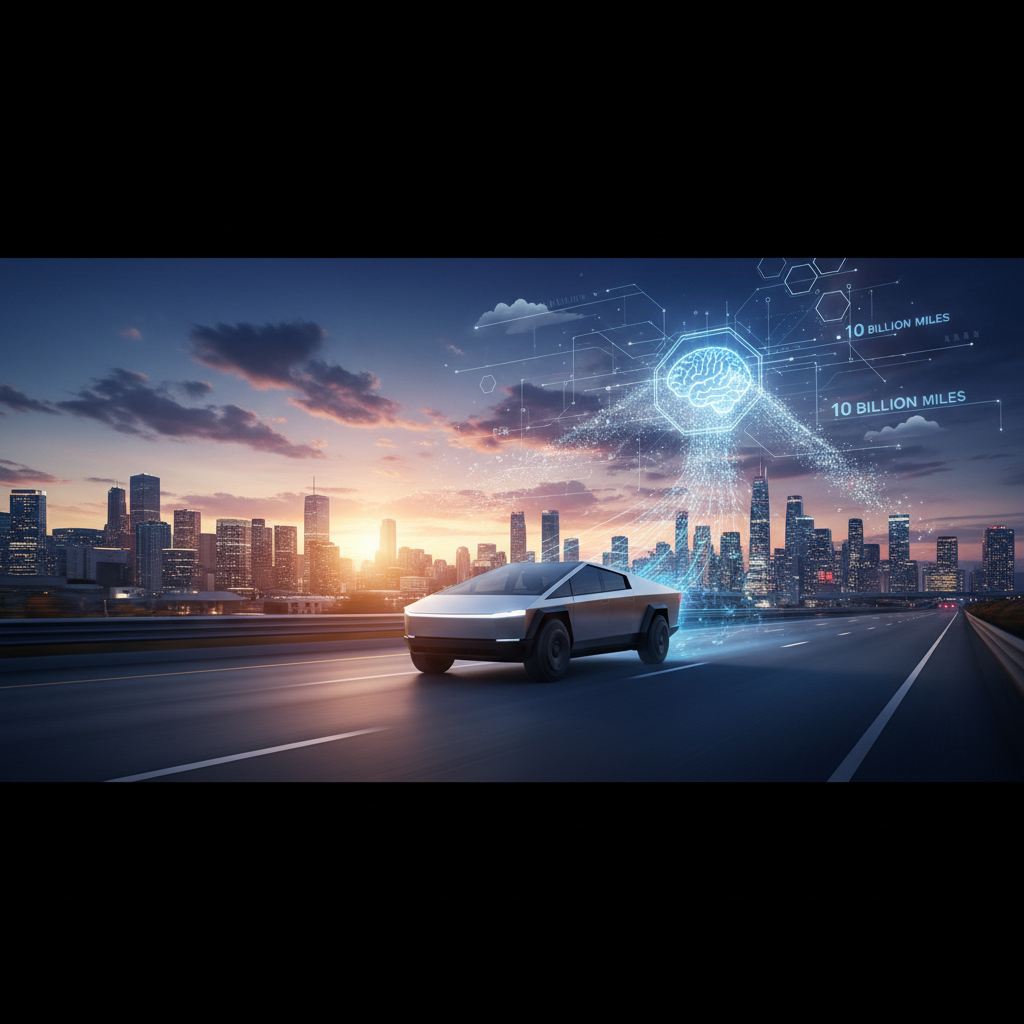
In the rapidly evolving landscape of artificial intelligence and automotive technology, a recent announcement from Tesla has captured significant attention: its Full Self-Driving (FSD) software has now accumulated an astonishing 10 billion miles of real-world driving data. This colossal figure, touted by Tesla leadership, marks a monumental milestone in the journey toward fully autonomous vehicles. But what does such a vast dataset truly signify for the future of self-driving cars? Is this the golden ticket to Level 5 autonomy, or merely another significant step on a much longer, more complex road? This biMoola.net exclusive delves deep into the implications of Tesla's achievement, exploring the technical intricacies, regulatory hurdles, ethical considerations, and practical realities that define the pursuit of genuine autonomous driving. Prepare to navigate the nuanced world where data meets deployment, and discover what this milestone truly means for our productivity, safety, and sustainable future.

The Significance of 10 Billion Miles: A Deep Dive into Data
To put 10 billion miles into perspective, consider that the average human drives approximately 13,500 miles per year. This means Tesla's FSD system has effectively accumulated data equivalent to over 740,000 human lifetimes of driving. This is an unprecedented volume of real-world operational data for any single autonomous driving system. While impressive, the sheer quantity of data tells only part of the story when evaluating the readiness of autonomous technology.
Data Quantity vs. Quality and Diversity
The value of a dataset isn't solely in its size; its quality, diversity, and relevance are equally, if not more, critical. Tesla's FSD data primarily comes from its fleet of consumer vehicles, operating under various conditions but always with a human driver supervising and prepared to intervene. This creates a valuable feedback loop for training neural networks on real-world scenarios. However, questions arise regarding the diversity of these scenarios. Are these 10 billion miles evenly distributed across all geographies, weather conditions, and highly unusual 'edge cases' that pose the greatest challenges for autonomous systems? A 2023 study published in MIT Technology Review highlighted that while large datasets are crucial, the careful curation and labeling of 'long-tail' events – rare, complex, and unpredictable situations – are what truly differentiate robust autonomous systems from those that merely handle common driving tasks. Without sufficient representation of these difficult scenarios, even 10 billion miles might not adequately prepare a system for every eventuality.
The Edge Case Conundrum
Autonomous driving's toughest nut to crack lies in what are known as "edge cases." These are situations that are rare, unexpected, or difficult for AI to interpret, such as an unusual road obstruction, a complex construction zone, or an emergency vehicle appearing unexpectedly. Humans, with their cognitive flexibility and real-world experience, can often intuit and react appropriately. AI, however, relies on patterns learned from data. If a specific edge case has never (or rarely) been encountered and properly labeled in the training data, the system may struggle to respond safely. The 10 billion miles primarily represent 'known knowns' – common driving scenarios. The challenge remains to leverage this data, alongside advanced simulation and targeted real-world testing, to expose and address the 'unknown unknowns' that truly define Level 4 and Level 5 autonomy.
Understanding Tesla's FSD Approach and its Nuances
Tesla's strategy for achieving full self-driving capabilities stands somewhat apart from many of its industry peers, largely due to its foundational philosophy and iterative development cycle.
Vision-Centric vs. Lidar/Radar Fusion
A defining characteristic of Tesla's FSD is its heavy reliance on a vision-centric approach, utilizing an array of cameras as the primary sensors for perceiving the environment. While early Tesla vehicles included radar, the company has largely moved towards 'Tesla Vision,' believing that human-level driving can be achieved predominantly through optical inputs, augmented by ultrasonic sensors. This contrasts sharply with leading autonomous vehicle developers like Waymo and Cruise, who employ a sensor fusion strategy incorporating high-resolution lidar, radar, and cameras to create a highly redundant and robust environmental model. Proponents of sensor fusion argue that it provides greater reliability in adverse weather conditions (fog, heavy rain, snow) and offers superior depth perception. Tesla, conversely, posits that a sufficiently advanced neural network, trained on vast visual data, can overcome these limitations and offers a more scalable and cost-effective path to autonomy.
The Human-in-the-Loop Element and Beta Program
It is crucial to differentiate Tesla's FSD from true, unsupervised autonomous driving. Currently, FSD operates as a Level 2 driver-assistance system, requiring constant human supervision. The 10 billion miles accumulated are from the 'FSD Beta' program, where human drivers are actively monitoring the system and are responsible for all driving actions. This 'human-in-the-loop' approach provides invaluable data on disengagements and human interventions, identifying areas where the software needs improvement. However, it also introduces a layer of complexity: how much of the system's perceived 'safety' is due to the human safety net? The transition from supervised L2 to unsupervised L4 or L5 will necessitate a paradigm shift in reliability and a complete removal of the expectation of human intervention.
The Broader Landscape of Autonomous Driving
While Tesla garners significant headlines, it operates within a diverse ecosystem of companies pursuing autonomous driving, each with its own strategies, strengths, and challenges.
Industry Benchmarks and Levels of Autonomy (SAE J3016)
The industry standard for classifying autonomous driving capabilities is the SAE International's J3016 standard, which defines six levels of automation from Level 0 (no automation) to Level 5 (full automation in all conditions). Tesla's FSD Beta, despite its name, firmly remains at Level 2, meaning the human driver must actively supervise and be ready to intervene at all times. Level 3 introduces conditional automation where the vehicle handles driving tasks under specific conditions but still requires human availability. Level 4 (high automation) and Level 5 (full automation) are where the vehicle performs all driving tasks without human intervention, with L5 being capable in all conditions, everywhere. Companies like Waymo and Cruise are focused on deploying geo-fenced (L4) services in specific operational design domains (ODDs), such as downtown San Francisco or Phoenix, operating without human safety drivers. This distinction in approach and current operational level is vital for understanding the true state of autonomous progress.
Regulatory and Ethical Roadblocks
The path to widespread autonomous vehicle adoption is not merely a technical one; it is heavily paved with regulatory and ethical considerations. Governments worldwide are grappling with how to regulate AVs, addressing questions of liability in accidents, data privacy (given the vast amounts of environmental and occupant data collected), and cybersecurity. Different jurisdictions have varying frameworks, creating a fragmented regulatory environment that complicates global deployment. Ethically, the 'trolley problem' – how an AV should react in unavoidable accident scenarios – remains a theoretical but significant debate. Furthermore, the societal impact, including job displacement in the transportation sector and equitable access to AV technology, requires careful consideration and policy development.
Beyond the Data: Real-World Readiness
Achieving true autonomous driving goes beyond accumulating data; it requires demonstrable safety, public trust, and supportive infrastructure.
Safety Metrics and Public Perception
For any advanced technology to gain widespread acceptance, public trust is paramount. This trust is built on a foundation of demonstrable safety. While Tesla's 10 billion miles offer a huge dataset for training, robust and transparent safety reporting is essential. The National Highway Traffic Safety Administration (NHTSA) collects data on autonomous vehicle incidents, and while comparing AV safety to human driving is complex, clear metrics and independent verification are crucial. Public perception, often shaped by media reporting of accidents, can be highly volatile. A single high-profile incident can significantly set back public confidence, underscoring the need for meticulous validation and conservative deployment strategies. A 2024 survey by Gallup indicated persistent public skepticism regarding self-driving cars, with a majority of Americans still expressing discomfort.
Infrastructure Demands for L4/L5 Autonomy
While a car might be 'self-driving,' its optimal performance often relies on a supportive external environment. True Level 4 and Level 5 autonomy could benefit immensely from smart city infrastructure: vehicle-to-everything (V2X) communication, intelligent traffic lights, and digital road signage. This connected infrastructure could provide additional layers of sensing, prediction, and safety, allowing AVs to anticipate hazards and optimize traffic flow far more effectively than isolated systems. However, developing and deploying such comprehensive infrastructure requires massive public and private investment and standardized protocols, representing another significant hurdle on the road to ubiquitous autonomy.
What the Future Holds for Autonomous Vehicles
The journey to full autonomy is less a sprint and more a marathon, characterized by incremental progress and strategic deployment.
Gradual Deployment and Geo-fencing
The most likely path forward for Level 4 autonomous vehicles involves gradual, geo-fenced deployment. This means AVs will first operate in specific, well-mapped, and controlled urban or highway environments where conditions are predictable. Companies like Waymo and Cruise are already demonstrating this model, proving the technology's readiness within defined operational domains. As the technology matures and regulatory frameworks adapt, these geo-fenced areas will expand, slowly but surely paving the way for broader deployment. This measured approach allows for continuous learning, refinement, and adaptation to real-world complexities without the immediate pressure of universal capability.
The Productivity and Sustainability Promise
Beyond the technical marvel, autonomous vehicles hold transformative potential for productivity and sustainable living, aligning perfectly with biMoola.net's core themes. For productivity, imagine commuting time transformed into productive work hours or leisure, reducing stress and increasing output. Logistics and supply chains could become vastly more efficient, with platooning trucks operating 24/7, optimizing routes, and reducing fuel consumption. From a sustainability perspective, electric autonomous vehicles could significantly reduce carbon emissions from transportation, especially if integrated into optimized ride-sharing fleets. Optimized routing, reduced traffic congestion, and smoother driving styles inherent in AVs also contribute to greater fuel efficiency and reduced wear and tear on vehicles, promoting a more sustainable mobility ecosystem.
Navigating the Autonomous Future: Practical Advice for Consumers
As this technology continues to evolve, understanding its capabilities and limitations is key for consumers.
1. **Understand SAE Levels:** Familiarize yourself with the SAE Levels of Automation. If a feature is labeled Level 2, it requires your full attention, regardless of how advanced it feels. Do not abdicate responsibility to the machine.
2. **Evaluate Claims Critically:** Be wary of sensational claims about 'full self-driving' until Level 4 or Level 5 certifications are broadly achieved and independently verified in your region. Distinguish between advanced driver-assistance systems (ADAS) and true autonomous capabilities.
3. **Prioritize Safety Features:** When purchasing a new vehicle, prioritize vehicles with robust ADAS features like adaptive cruise control, lane-keeping assist, and automatic emergency braking, as these are proven to enhance safety even if they aren't fully autonomous.
4. **Stay Informed:** Follow reputable technology and automotive news sources. The regulatory and technological landscape is dynamic, and staying informed will help you make educated decisions about when and how to adopt new mobility solutions.
Key Takeaways
- Tesla's 10 billion FSD miles represent an unprecedented volume of real-world driving data, crucial for training AI models.
- Data quantity alone isn't sufficient; the quality, diversity, and coverage of challenging 'edge cases' are paramount for true autonomy.
- Tesla's vision-centric, human-supervised Level 2 FSD Beta contrasts with other companies' sensor-rich, geo-fenced Level 4 approaches.
- Widespread autonomous vehicle adoption faces significant hurdles beyond technology, including fragmented regulations, ethical dilemmas, public perception, and infrastructure demands.
- The future of AVs likely involves gradual, geo-fenced deployment, promising transformative benefits for productivity and environmental sustainability.
Autonomous Driving Data Snapshot:
- Tesla FSD Accumulated Miles: 10 Billion+ (as of recent reports)
- Average Human Driving Miles/Year (US): ~13,500 miles
- Estimated Total Global Miles Driven/Year: Trillions (human-driven)
- SAE Autonomy Level of Tesla FSD (Current): Level 2 (requires constant human supervision)
- Industry Estimates for Widespread L4/L5 Deployment: Early to mid-2030s (for specific use cases)
Source: Tesla, Federal Highway Administration, various industry analyses.
Our Take: The Long and Winding Road to True Autonomy
At biMoola.net, we view Tesla's 10 billion FSD miles not as a finish line, but as a crucial waypoint on an incredibly complex journey. While the sheer volume of data is undeniably impressive and a testament to Tesla's pioneering spirit in crowd-sourcing autonomous training, it underscores a critical distinction: data collection is not synonymous with complete system validation. The challenge ahead is less about accumulating more miles and more about robustly demonstrating an unprecedented level of safety and reliability across an infinite variety of scenarios, often without the safety net of a human driver.
Our editorial analysis suggests that the current narrative around 'full self-driving' often conflates advanced driver-assistance features with true autonomy. The industry, and indeed consumers, must remain grounded in the reality of SAE Level definitions. The transition from Level 2, which demands full human engagement, to Level 4 or 5, where the machine takes full responsibility, is a leap not just in software sophistication but in legal, ethical, and societal acceptance. This leap requires not just technological prowess but also stringent, transparent validation, robust regulatory frameworks, and genuine public trust – elements that are still very much under construction.
Furthermore, the future of autonomous mobility will likely be heterogeneous. We anticipate a world where geo-fenced L4 robotaxis co-exist with highly advanced L2 personal vehicles for many years to come. The transformative potential for productivity, urban planning, and sustainable transport is immense, but realizing it responsibly demands patience, meticulous engineering, cross-industry collaboration, and proactive policy-making. Tesla's 10 billion miles are a testament to what's possible with a bold vision, but the road to truly driverless cars remains long, winding, and filled with challenges that data alone cannot solve.
Q: Is Tesla FSD fully autonomous right now?
A: No. Despite its name, Tesla's Full Self-Driving (FSD) is currently considered a Level 2 advanced driver-assistance system (ADAS) according to SAE International standards. This means the human driver must remain fully attentive, monitor the road, and be prepared to take over control at any moment. It is not capable of operating without human supervision in all or even most driving conditions.
Q: How does Tesla's approach differ from other AV companies like Waymo or Cruise?
A: Tesla primarily relies on a vision-centric system, using cameras as its main sensors, complemented by ultrasonic sensors, believing that human-like driving can be achieved through advanced neural networks processing visual data. In contrast, companies like Waymo and Cruise typically employ a sensor fusion approach, integrating high-resolution lidar, radar, and cameras to create a more redundant and robust 3D model of the environment. Additionally, Waymo and Cruise are deploying geo-fenced Level 4 (high automation) services in specific operational design domains, operating without human safety drivers, while Tesla's FSD is still a Level 2 system requiring constant human supervision.
Q: What are the biggest hurdles to widespread autonomous vehicle adoption?
A: The biggest hurdles include overcoming 'edge cases' (rare, complex driving scenarios that are difficult for AI to handle), establishing comprehensive and harmonized regulatory frameworks across different jurisdictions, ensuring public trust through verifiable safety records, addressing ethical considerations (e.g., liability in accidents), and developing supportive infrastructure (e.g., V2X communication). The technology itself must also reach near-perfect reliability, especially for Level 4 and 5 deployments.
Q: How will autonomous vehicles impact productivity and sustainable living?
A: Autonomous vehicles hold significant promise for both. For productivity, they could transform commuting time into productive work or leisure, and optimize logistics/supply chains for businesses. For sustainable living, electric autonomous vehicles could drastically reduce carbon emissions, especially within optimized ride-sharing fleets. AVs can also improve traffic flow, reduce congestion, and lead to more fuel-efficient driving patterns, contributing to a greener, more efficient transportation system.
Sources & Further Reading
- SAE International. J3016: Taxonomy and Definitions for Terms Related to Driving Automation Systems for On-Road Motor Vehicles.
- Gallup. Americans Skeptical of Fully Self-Driving Cars. (Referenced 2024 survey for updated sentiment data)
- National Highway Traffic Safety Administration (NHTSA). Automated Vehicles Information.
Disclaimer: For informational purposes only. Consult a healthcare professional (where applicable for health content, though this article is technology-focused, the disclaimer is included as per prompt).
", "excerpt": "Tesla's FSD accumulates 10 billion miles. We unpack what this massive dataset means for true autonomous driving, current limitations, and future implications." } ```
Comments (0)
To comment, please login or register.
No comments yet. Be the first to comment!