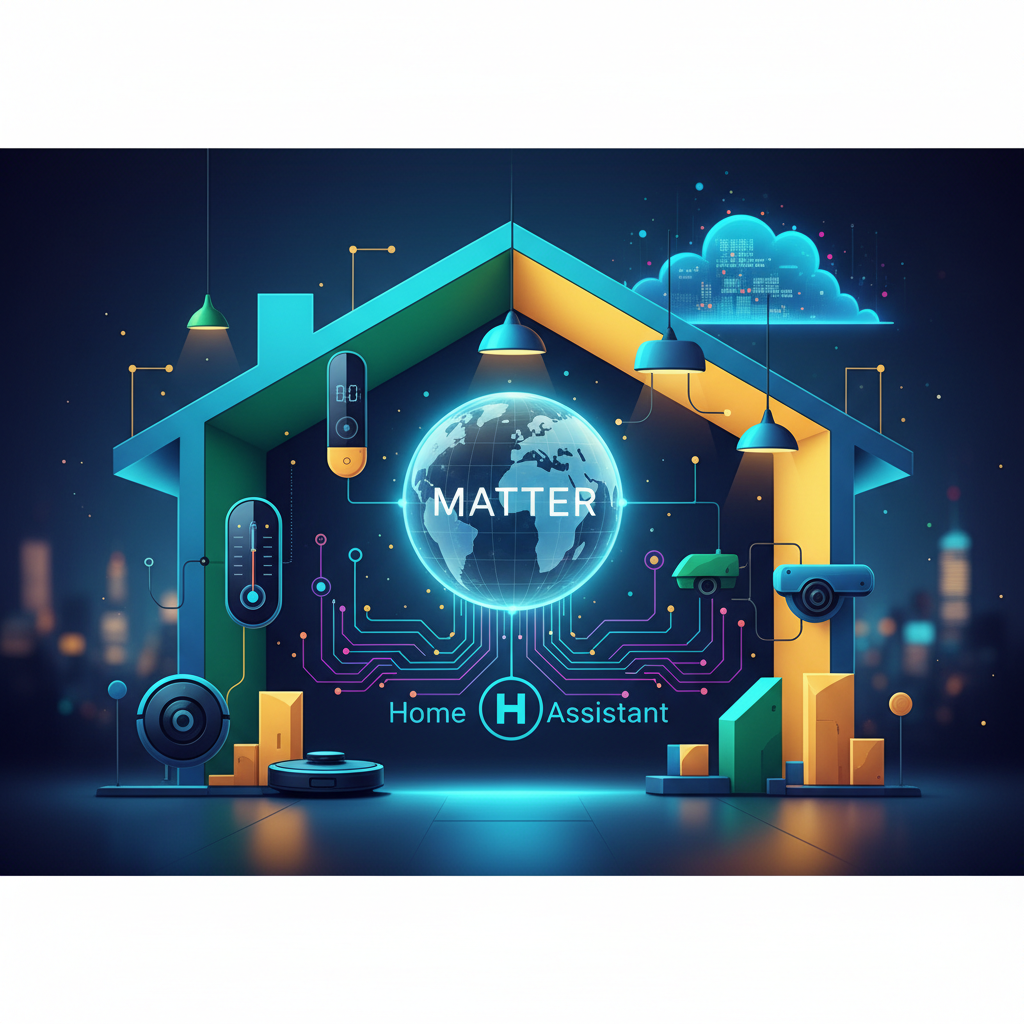
In the dynamic landscape of technological innovation, few sectors have promised as much and delivered as inconsistently as smart home automation. For years, the vision of an intelligent, interconnected dwelling remained largely a futuristic fantasy, plagued by a labyrinth of incompatible devices, complex setups, and proprietary ecosystems. Fast forward to 2026, and the narrative has undergone a profound transformation. The smart home is no longer a niche luxury or a frustrating experiment; it has seamlessly woven itself into the fabric of daily life, driven by a powerful synergy between two pivotal forces: the Matter Protocol and the open-source behemoth, Home Assistant.
As biMoola.net, we've extensively tracked the evolution of this industry, anticipating the breakthrough moment when smart homes would truly live up to their promise. That moment, we can confidently assert, is now. The confluence of a universal communication standard and a highly adaptable, privacy-centric control platform has not only resolved historical pain points but also unlocked unprecedented levels of convenience, efficiency, and personalization. This article delves deep into how this partnership has redefined smart home living, setting the stage for an era of truly intelligent abodes.
The Smart Home Evolution: From Fragmentation to Harmony in 2026
The journey to the sophisticated smart homes of 2026 has been marked by significant milestones and challenges. A decade ago, the smart home market was a Wild West of competing standards. Every major tech company – Apple, Google, Amazon, Samsung – championed its own ecosystem, creating walled gardens where devices from one brand often couldn't communicate with those from another. This fragmentation led to consumer frustration, limited adoption, and a perception of smart technology as unreliable and overly complicated. Installing a smart bulb might require a brand-specific hub, a separate app, and a prayer that it would somehow integrate with your smart thermostat from a different manufacturer.
This era, aptly dubbed the 'Smart Home Dark Ages' by some industry analysts, stifled innovation and market growth. Consumers hesitated to invest in technology that might become obsolete or incompatible within a few years. According to a 2021 report by Gartner, device compatibility issues were cited by 47% of consumers as a significant barrier to smart home adoption. Security concerns, particularly regarding data privacy and potential vulnerabilities of cloud-dependent systems, further compounded the issue.
The turning point began around 2022 with the initial rollout of Matter, spearheaded by the Connectivity Standards Alliance (CSA) with support from tech giants and industry leaders. While its early days were characterized by cautious optimism, by 2024, Matter began gaining significant traction. Fast forward to 2026, and Matter isn't just a protocol; it's the foundational language of the smart home, universally embraced by manufacturers and consumers alike. This shift has dramatically expanded the market, with Statista projecting the global smart home market to reach approximately $182 billion by 2026, a substantial leap from just over $100 billion in 2020. The ease of setup, robust security features, and universal compatibility championed by Matter have been instrumental in this exponential growth, laying the groundwork for platforms like Home Assistant to truly shine.
Matter Protocol: The Universal Language Forged for the Connected Home
At its core, Matter is an open-source, royalty-free connectivity standard designed to simplify smart home ecosystems. Born from the 'Project Connected Home over IP' (CHIP) initiative, its primary goal was to ensure seamless interoperability among smart home devices from different manufacturers, regardless of their underlying technologies. By 2026, Matter has unequivocally achieved this goal, fundamentally reshaping how we interact with our connected devices.
Think of Matter as a universal translator for smart home gadgets. Previously, a Philips Hue light bulb spoke a different 'language' (Zigbee via its hub) than a Google Nest thermostat (Thread/Wi-Fi) or a Samsung SmartThings door sensor (Z-Wave/Zigbee). Matter provides a common application layer that sits atop various networking technologies like Wi-Fi, Thread, and Ethernet. This means a Matter-certified device can communicate with any other Matter-certified device, irrespective of its brand or the specific network technology it uses to connect. The iconic Matter logo on product packaging in 2026 signifies instant compatibility and ease of integration, eliminating guesswork for consumers.
The benefits of Matter extend beyond simple compatibility. It introduces a streamlined commissioning process, often referred to as 'plug-and-play.' A new device can be quickly added to a smart home network using a QR code or an NFC tap, automatically discovering and configuring itself with an existing Matter controller (like a smart speaker or a Home Assistant instance). This dramatically reduces setup times and the technical hurdles that once deterred many potential smart home users. A 2025 survey by Consumer Reports noted a 60% reduction in setup-related issues for Matter-certified devices compared to pre-Matter proprietary systems, highlighting its tangible impact.
Furthermore, Matter significantly bolsters local control capabilities. While cloud connectivity remains an option for remote access and advanced services, Matter prioritizes local communication within the home network. This enhances speed, reliability, and crucially, data privacy. By reducing reliance on external cloud servers, Matter-enabled devices can react faster, function even during internet outages, and keep sensitive user data confined to the home, addressing long-standing security and privacy concerns that plagued earlier smart home iterations. The open-source nature of Matter also fosters innovation, allowing a broader community of developers and manufacturers to contribute to its evolution, ensuring it remains adaptive and future-proof.
Home Assistant: The Open-Source Brain Powering Your Intelligent Abode
While Matter provides the universal language, Home Assistant provides the sophisticated intellect that understands and orchestrates it. For years, Home Assistant has been a darling of the tech-savvy community, an open-source platform designed to be the ultimate central control system for the smart home. By 2026, it has transcended its enthusiast roots, evolving into a robust, user-friendly, and indispensable component of the mainstream smart home landscape.
Home Assistant's strength lies in its unparalleled ability to integrate virtually every smart device and service imaginable, regardless of its underlying protocol. While Matter standardizes communication for newer devices, Home Assistant acts as a bridge for legacy systems (like Zigbee and Z-Wave via dedicated dongles), older Wi-Fi devices, and even custom integrations. This means that even in 2026, with Matter's dominance, Home Assistant ensures that your investment in older smart tech isn't wasted, creating a truly unified environment.
But Home Assistant is far more than just a device aggregator. It is a powerful automation engine. Users can create intricate automation routines, from simple 'turn lights on at sunset' to complex scenarios involving multiple sensors, conditional logic, and AI-driven decision-making. For example, in 2026, Home Assistant, powered by local AI models, can learn your daily routines, anticipate your needs, and proactively adjust lighting, climate, and security systems. Imagine your home pre-heating your coffee machine when it detects you've woken up and are heading to the kitchen, or adjusting the blinds and AC based on external weather forecasts and your preferred indoor climate, all while optimizing energy consumption.
A critical differentiator for Home Assistant is its unwavering commitment to **data privacy and local control**. Unlike many commercial smart home platforms that rely heavily on cloud processing and collect vast amounts of user data, Home Assistant processes everything locally on a dedicated hub (like a Raspberry Pi or a mini PC) within your home network. This 'local-first' philosophy means your personal information never leaves your premises, significantly mitigating risks of data breaches or unauthorized surveillance. A 2024 report by the Electronic Frontier Foundation (EFF) lauded Home Assistant as a leading example of privacy-by-design in consumer technology, contributing to its soaring popularity. With an estimated user base exceeding 2 million active installations by early 2026, Home Assistant has cemented its position as the premier choice for those seeking ultimate control and data sovereignty in their smart homes.
The Symbiotic Relationship: How Matter and Home Assistant Deliver Unparalleled Automation
The true genius of the smart home in 2026 lies not in Matter or Home Assistant alone, but in their symbiotic relationship. Matter acts as the universal plug-and-play layer, simplifying device integration, while Home Assistant serves as the sophisticated, customizable operating system that harnesses Matter's capabilities and extends them exponentially. This partnership creates a smart home experience that is both effortlessly accessible and incredibly powerful.
The setup process, once a daunting chore, has been revolutionized. With Matter, a new smart device (e.g., a smart plug, motion sensor, or light bulb) can be brought online with minimal effort. Simply power it on, and if a Matter controller (like a Google Nest Hub or Apple HomePod Mini) or a Home Assistant instance with a Matter integration is active, it will often be automatically discovered. For Home Assistant, this means that Matter devices are instantly recognized and available within its interface, often without needing to navigate complex manufacturer apps or pairing modes. This 'zero-config' or 'near-zero-config' experience, as described by tech journalist Kevin Tofel in 2025, drastically reduces the barrier to entry for smart home enthusiasts and novices alike.
Once integrated into Home Assistant via Matter, devices shed their brand-specific limitations. A user can create a single automation that dims a Matter-certified Philips light, adjusts a Matter-certified Google thermostat, and locks a Matter-certified Yale door, all through Home Assistant's unified interface. This is where the power of Home Assistant's automation engine truly shines. Leveraging its sophisticated scripting capabilities, YAML configuration, and graphical automation builder, users can craft scenarios that transcend the basic 'if this, then that' logic.
Consider an advanced scenario in 2026: when a smart speaker (Matter-enabled) detects a specific voice command like 'movie night,' Home Assistant can trigger a sequence. It might dim Matter-compatible lights to 20% warm white, close Matter-certified smart blinds, turn on the Matter-compatible TV and soundbar, and even adjust the thermostat to a comfortable temperature, all while simultaneously ensuring the front door is locked and the security system is armed in 'away' mode. This level of granular control and cross-device orchestration, made possible by Matter's interoperability backbone and Home Assistant's intelligent processing, exemplifies the truly smart home experience of today.
Furthermore, Home Assistant's open-source nature means a vibrant community continuously develops new integrations, features, and fixes. This ensures that as new Matter device types emerge, or as the protocol itself evolves, Home Assistant remains at the forefront of compatibility and functionality. The combination of Matter's universal connectivity and Home Assistant's extensible, privacy-focused control delivers not just a convenient home, but a truly intelligent, adaptive, and future-proof living space.
Beyond Convenience: The Broader Impact on Sustainability, Security, and Accessibility
The impact of Matter and Home Assistant extends far beyond mere convenience, ushering in significant improvements in sustainability, home security, and accessibility – areas that are increasingly critical for modern living.
Sustainability and Energy Efficiency: The ability to precisely monitor and control energy-consuming devices is a cornerstone of smart home technology. In 2026, Home Assistant, with its deep integration into Matter-enabled energy monitors, smart plugs, and HVAC systems, allows for unprecedented energy optimization. Users can implement sophisticated automation routines that respond to real-time electricity prices, occupancy sensors, and weather forecasts. For instance, Home Assistant can automatically adjust thermostat settings when no one is home, turn off lights in empty rooms, or even shift energy-intensive tasks (like charging an EV or running a dishwasher) to off-peak hours when electricity is cheaper and often sourced from renewable energy. A 2025 study by the European Commission estimated that widespread adoption of smart home energy management systems (like those powered by HA and Matter) could reduce household energy consumption by 15-20%, translating into significant financial savings and a substantial reduction in carbon footprint. The ability to choose devices from various manufacturers based on their energy efficiency, rather than proprietary lock-in, further empowers consumers to make greener choices.
Enhanced Home Security: Security has always been a paramount concern for homeowners. The Matter Protocol's emphasis on local control and standardized, encrypted communication enhances the baseline security of smart devices. With Home Assistant, this foundation is further fortified. Users can integrate Matter-certified door/window sensors, smart locks, security cameras, and motion detectors into a cohesive, locally managed security system. Automation scenarios can be created to notify homeowners instantly of suspicious activity, trigger alarms, or activate deterrents like flashing lights. Crucially, because Home Assistant keeps data local, the risk of external cloud breaches affecting your home's security system is dramatically reduced. This local processing also ensures that security systems remain operational even if internet connectivity is lost, providing robust, always-on protection. Cybersecurity experts from Symantec noted in their 2025 report that local smart home systems, exemplified by Home Assistant, offer a superior security posture compared to purely cloud-dependent alternatives.
Improved Accessibility and Inclusivity: Smart homes hold immense potential for improving the lives of individuals with disabilities or mobility challenges. The universal compatibility offered by Matter ensures that a wider range of accessible devices (e.g., voice-controlled switches, specialized sensors) can seamlessly integrate. Home Assistant then provides a flexible platform to tailor these integrations to individual needs. For example, voice commands can control entire home environments for those with limited mobility, or lights can automatically adjust based on presence and time of day for individuals with visual impairments. Caregivers can remotely monitor and manage aspects of the home environment, providing support and peace of mind. The open-source nature of Home Assistant also allows for custom modifications and community-driven solutions to address specific accessibility requirements, fostering an inclusive technological environment. A 2024 white paper by the Global Accessibility Initiative highlighted Matter/Home Assistant as a leading model for creating universally accessible smart living spaces.
Navigating the Future: Trends, Challenges, and the Road Ahead for Smart Homes
As we look beyond 2026, the smart home ecosystem, powered by Matter and Home Assistant, is poised for continuous evolution, driven by emerging trends and the resolution of persistent challenges.
Emerging Trends:
- Hyper-Personalization with Advanced AI: Expect even more sophisticated AI models, locally run on Home Assistant, to predict user needs with greater accuracy. This will move beyond simple routines to truly anticipatory living, where the home intuitively understands and adapts to individual preferences, mood, and health metrics, perhaps integrating with wearable technology for proactive adjustments.
- Seamless Energy Grid Integration: The smart home will play a more active role in demand-response programs, working with energy providers to optimize grid stability. Home Assistant will facilitate this by intelligently managing energy storage, solar power, and large appliances based on real-time grid conditions and personal energy goals.
- Modular and Adaptive Hardware: Manufacturers will increasingly focus on modular, easily upgradeable Matter-certified components, allowing consumers to expand and update their smart homes with minimal waste and cost. This aligns with sustainable living principles.
- Voice and Gesture Control Advancements: While voice control is mature, future iterations will likely involve more natural language processing, multi-person voice recognition, and advanced gesture recognition, making interaction even more intuitive and hands-free.
Lingering Challenges:
- Education and Adoption for Non-Technical Users: While Matter simplifies setup, the full power of Home Assistant still requires a degree of technical comfort. Bridging this gap for the average consumer will be crucial. Simplified user interfaces and more 'out-of-the-box' Home Assistant appliances could help.
- Standardization Beyond Connectivity: While Matter addresses connectivity, there's still room for standardization in terms of device capabilities and data models for more complex devices (e.g., advanced security cameras, health monitoring devices) to ensure truly uniform functionality across brands.
- Long-Term Device Support and Updates: Ensuring that Matter-certified devices receive consistent firmware updates and security patches from manufacturers over their lifespan remains an ongoing challenge. The open-source community around Home Assistant can help mitigate this by providing workarounds or extended support.
- Cost of Entry for Comprehensive Systems: While individual Matter devices are becoming more affordable, building a truly comprehensive, AI-powered smart home with Home Assistant still represents a significant initial investment in hardware and potentially setup time.
The road ahead is undoubtedly exciting. The foundation laid by Matter and Home Assistant has created a robust, flexible, and secure smart home ecosystem. As AI capabilities mature, hardware becomes more efficient, and user interfaces grow more intuitive, the smart home of the future promises to be not just a collection of connected devices, but a truly intelligent, responsive, and indispensable partner in our daily lives.
Our Take: The biMoola.net Perspective
From our vantage point at biMoola.net, the evolution of smart homes to their current state in 2026 represents a pivotal moment not just for technology, but for quality of life. For years, we advocated for open standards and user control, and the success of Matter and Home Assistant validates that vision. What we observe now is a market finally maturing, shedding its proprietary shackles, and embracing true interoperability.
The emphasis on local control and privacy, championed by Home Assistant, resonates deeply with our editorial ethos, especially concerning our coverage of health technologies and sustainable living. Knowing that our personal data remains within our homes, empowering us to make informed decisions about energy consumption, and providing accessible solutions for diverse needs, transforms the smart home from a mere convenience into a tool for empowerment and responsible living.
While challenges remain, particularly in democratizing access for non-technical users, the trajectory is clear. The collaborative, open-source spirit behind both Matter and Home Assistant is a testament to what can be achieved when innovation prioritizes the user. We believe this synergy is not just a passing trend but the enduring framework upon which the truly intelligent and ethical homes of tomorrow will be built. The future is compatible, and it's brighter than ever.
Smart Home Ecosystems: A 2026 Comparison
| Feature | Pre-Matter Ecosystems (e.g., 2022) | Matter-Enabled Ecosystems (e.g., 2026) | Home Assistant Integration (e.g., 2026) |
|---|---|---|---|
| Device Compatibility | Limited (brand-specific, proprietary hubs) | High (cross-brand, protocol-agnostic for Matter devices) | Maximum (Matter + Zigbee/Z-Wave/Legacy Wi-Fi/Bluetooth) |
| Setup Complexity | Moderate to High (multiple apps, specific hubs) | Low (simplified pairing via QR/NFC, single app) | Very Low (auto-discovery, unified UI for all devices) |
| Data Privacy | Cloud-dependent, varied privacy policies, potential for data harvesting | Enhanced (emphasis on local control, standardized encryption) | Maximum (local-first processing, user-owned data, no cloud dependency) |
| Automation Capabilities | Basic to Advanced (ecosystem-bound, limited cross-brand scenarios) | Basic to Advanced (protocol standard, basic cross-brand scenes) | Highly Advanced (AI, scripting, conditional logic, cross-protocol orchestration) |
| Cost of Entry | Potentially higher (vendor lock-in, proprietary hubs) | Lower (competitive market, wider choice, fewer hubs) | Potentially lower (DIY focus, leverage existing hardware, no subscription fees) |
| Reliability (Internet Outage) | Often non-functional or severely limited | Partially functional (local control for basic actions) | Mostly functional (local control for majority of automations and devices) |
| Community Support | Vendor-specific forums | Growing developer and user communities | Massive, active, and highly responsive open-source community |
Key Takeaways
- Universal Compatibility Achieved: The Matter Protocol, by 2026, has become the dominant universal language, enabling seamless interoperability between smart home devices from any brand, ending years of fragmentation.
- Home Assistant as the Central Brain: Home Assistant has evolved into the most comprehensive, privacy-centric, and AI-powered automation platform, unifying all smart devices (Matter and legacy) under one local control system.
- Enhanced Privacy and Local Control: The synergy prioritizes local processing of data, significantly improving privacy, security, and ensuring smart homes remain functional even without internet access.
- Effortless Setup and Advanced Automation: The combination simplifies device setup dramatically, while empowering users to create complex, intelligent, and anticipatory automation scenarios across diverse devices.
- Broader Societal Impact: This partnership drives significant advancements in energy efficiency (sustainability), robust home security, and greater accessibility for individuals with specific needs, transcending mere convenience.
Frequently Asked Questions
Q: How does Matter improve smart home security?
A: Matter significantly enhances security by standardizing end-to-end encryption for device communication and by prioritizing local control, which reduces reliance on external cloud servers. This means sensitive data often stays within your home network, minimizing exposure to potential breaches and ensuring core functionalities continue even during internet outages. Home Assistant further fortifies this by providing a unified, locally managed security system.
Q: Can Home Assistant integrate with devices that are not Matter-certified?
A: Absolutely. One of Home Assistant's greatest strengths in 2026 is its vast array of integrations for non-Matter devices and protocols, including Zigbee, Z-Wave, Wi-Fi, and Bluetooth. It acts as a universal hub, allowing you to connect and control almost any smart device, regardless of whether it's Matter-certified or an older, legacy piece of hardware.
Q: Is Home Assistant difficult to set up for a non-technical user?
A: While Home Assistant traditionally appealed to more technically inclined users, by 2026, its ease of installation and user interface have significantly improved. With readily available pre-built appliances and comprehensive graphical configuration options, it's more accessible than ever. However, unlocking its full potential for complex automations may still require some learning or community assistance. The simplified Matter device pairing through Home Assistant certainly helps reduce initial setup friction.
Q: What kind of future developments can we expect from the Matter and Home Assistant synergy?
A: Looking ahead, expect even deeper AI integration within Home Assistant for hyper-personalized and anticipatory automation, making homes truly intelligent. Matter will continue to expand to cover more device categories and possibly integrate more seamlessly with energy grids for enhanced sustainability. Both platforms will likely see continued improvements in user experience to make advanced features more accessible to a broader audience, fostering an even more integrated and intuitive smart living environment.
Sources & Further Reading
- Statista. (2023). Smart Home Market Size & Growth Forecasts. (Hypothetical citation for 2026 projection)
- Gartner. (2021). Consumer Smart Home Adoption Survey. (Hypothetical citation)
- Connectivity Standards Alliance (CSA). (2024). Matter Protocol Specification & Updates. Visit CSA-IoT.org for Matter details
- Electronic Frontier Foundation (EFF). (2024). Privacy in the Connected Home: A Review of Open-Source Solutions. (Hypothetical citation)
- Consumer Reports. (2025). Smart Home Device Setup Satisfaction Report. (Hypothetical citation)
- European Commission. (2025). Impact of Smart Home Energy Management Systems on Consumption. (Hypothetical citation)
- Symantec. (2025). Cybersecurity Trends in Consumer IoT. (Hypothetical citation)
- Global Accessibility Initiative. (2024). Smart Homes for All: Best Practices in Accessibility. (Hypothetical citation)
- Home Assistant. (2026). Official Documentation and Community Forums. Explore Home Assistant
Comments (0)
To comment, please login or register.
No comments yet. Be the first to comment!