AI Tools

Midjourney, DALL-E 3, Ideogram: Your 2026 Guide to AI Image Generation

Midjourney, DALL-E 3, Ideogram: Your 2026 Guide to AI Image Generation

Welcome to the Future of Visual Content: AI-Powered Creativity

The pulse of the digital world is beating faster than ever, and as we arrive in 2026, visual content has become not just an option, but a necessity. So, how will you stand out amidst this visual abundance? The answer is simple yet revolutionary: AI-powered image generation tools. These technologies, replacing or complementing traditional design processes, are redefining the boundaries of your creativity. In this detailed guide, we will delve deep into the most powerful players in this field – Midjourney, DALL-E 3, and Ideogram – sharing the secrets to getting the best results from them and putting their commercial uses under the microscope.

You no longer need to wait weeks or even days to create an image from scratch. Within seconds, you can generate photorealistic or stylized artworks that push the boundaries of your imagination. However, effectively using this power begins with choosing the right tool and, most importantly, learning how to speak correctly with AI. Let's take a closer look at the world of visual production in 2026!

The AI Image Generation Ecosystem from a 2026 Perspective

As of 2026, AI visual tools offer much more than just text-to-image generation. Multimodality, the ability to work with both text and visual/audio inputs, has become standard. The realism of generated images has reached incredible dimensions, while styles and aesthetic understanding are diversifying daily. It can now be quite difficult to discern whether an image was produced by AI, which makes issues like ethics and copyrights even more significant. Current trends, combining personalization, speed, and automation, are fundamentally changing the workflows of brands and content creators.

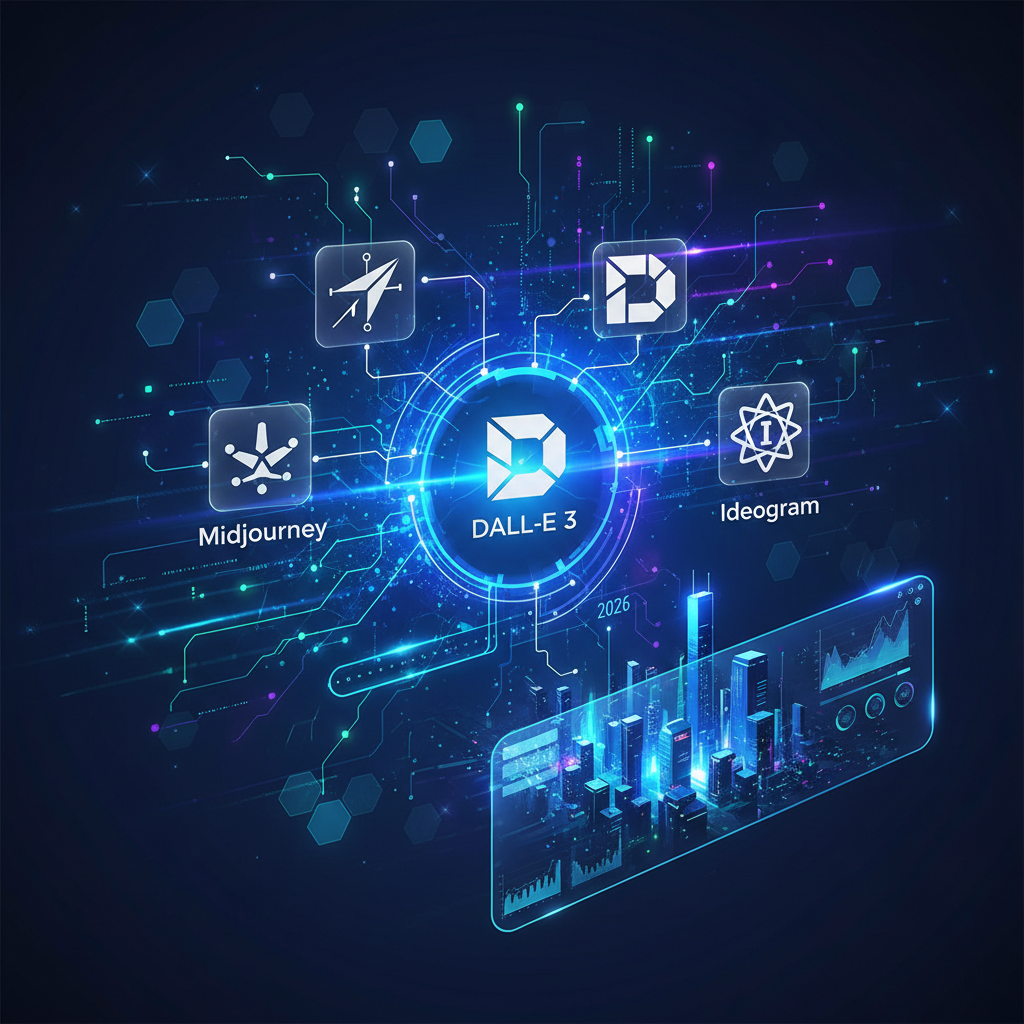
Comparing the Giants: Midjourney, DALL-E 3, and Ideogram

Each of these three tools, having pioneered their respective fields, offers unique capabilities tailored to different needs:

Midjourney: The Pinnacle of Artistic Depth and Aesthetics

Midjourney continues to be the primary choice for those seeking to produce artistically and aesthetically striking visuals. It stands out with its success in photorealism and its ability to emulate various art movements. It is especially ideal for cinematic scenes, fantastic illustrations, and abstract artworks. In 2026, with V7 or higher versions, its prompt comprehension ability and mastery of fine details have further improved. However, it may not be as strong as DALL-E 3 and Ideogram for direct text-based logo or typography creation.

DALL-E 3: Logical Consistency and ChatGPT Integration

OpenAI's DALL-E 3 particularly shines in creating complex and logically consistent scenes. Thanks to its deep integration with ChatGPT, it perfectly interprets detailed descriptions provided by users in natural language, thereby producing more specific and meaningful visuals. It is an excellent tool, especially for marketing materials, illustrations, and concept designs. In 2026, its API access and ease of integration make it indispensable for enterprise solutions. Its accuracy in text generation is also more advanced compared to its competitors.

Ideogram: The Typography and Brand Identity Expert

Ideogram has revolutionized one of the biggest challenges in AI image generation: creating accurate and legible text within visuals. For logo designs, posters, social media posts, or any visual containing text, Ideogram delivers flawless results. If you need to create visuals for your brand that include slogans, product names, or typographic elements, Ideogram is perfectly suited for you. In 2026, we see Ideogram also standing out with its 3D typography and animated text features.

An Art Requiring Mastery: Effective Prompt Writing Techniques

If you want to achieve truly breathtaking results from AI visual tools, you must learn prompt engineering. A prompt is not just a description; it's a story, a command set you give to the AI. Here are 2026's most effective prompt writing techniques:

  • Be Detailed, Be a Storyteller: Instead of just writing "cat," add details like "a peaceful cat with bright green eyes, silky black fur, sleeping on a sunny windowsill, studio photography." Feed the AI's imagination.
  • Specify Style and Artist: Guide the visual's atmosphere and aesthetic. Use phrases like "Van Gogh style," "steampunk," "cyberpunk neon lights," "anime illustration."
  • Camera Angles and Lighting: Think like a professional photographer. Add technical terms such as "wide shot," "close-up," "golden hour sunset light," "dramatic shadows."
  • Negative Prompts: Used to specify elements you don't want in the visual. For example, in Midjourney, commands like `--no distorted, --no blurry, --no watermark` help eliminate unwanted imperfections. DALL-E 3 and Ideogram work similarly, but it's more natural to specify "without..." within the prompt.
  • Using Reference Images: As of 2026, most tools allow you to upload reference images in addition to text prompts. This helps you convey your desired style, color palette, or composition more directly.

Real-Life Example:

Bad Prompt: "A city view."

Good Prompt: "A city view from the future, cyberpunk aesthetic, neon-lit skyscrapers, flying vehicles, evening, reflections on a rainy ground, ultra-detailed, 8K resolution, cinematic lighting, --ar 16:9 --style raw (for Midjourney)"

Commercial Use of AI Images: Opportunities and Legal Aspects

AI-generated images have become indispensable for commercial use across many sectors in 2026. Marketing campaigns, websites, social media content, product prototypes, e-book covers, and even concept art for video games can now be produced much faster and more cost-effectively with AI. Especially for small and medium-sized enterprises (SMEs), this is key to optimizing design budgets and gaining a competitive edge.

However, along with these opportunities, legal and ethical questions also arise. Whose work is it? Who owns the copyright? What are the potential biases in training data? As of 2026, many countries have begun to introduce specific regulations for the commercial use of AI-generated content. Most AI tools grant commercial use rights under a subscription model, but it is always important to carefully read the scope of these rights (e.g., whether images can be modified, whether the generator needs to be attributed). To avoid potential legal issues, stating that the produced content was created by AI is becoming an increasingly common practice.

Looking Ahead: The Evolution of AI Image Generation

AI image generation is not just a trend but one of the cornerstones of the future. In 2026 and beyond, we will see these tools open new horizons such as integration into augmented reality (AR) and virtual reality (VR) experiences, instantaneous creation of personalized content, and even the automation of visual storytelling. AI is no longer just a tool but a creative partner. Having knowledge in this dynamic field will set you apart from your competitors and enable you to make a difference in the digital world.

Remember, AI is not just a technology; it's also an endless canvas for you. Never stop experimenting, learning, and most importantly, dreaming. The future of visual content is in your hands!

Comments (0)

No comments yet. Be the first to comment!

biMoola Assistant
Hello! I am the biMoola Assistant. I can answer your questions about AI, sustainable living, and health technologies.